
Loading lot details…
The May 2021 Auction: Part 4
Swipe left for previous · Swipe right for next
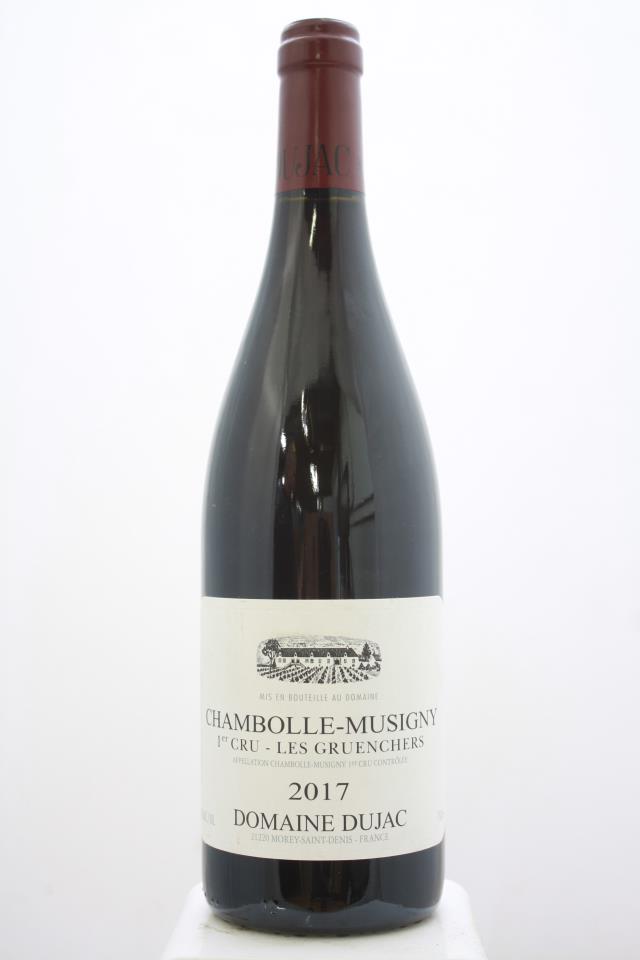 1 / 2
Lot 127
Estimate: $650
Nicked, lightly scuffed labels.
Sold:
This auction has ended. Bidding is closed.
Collection name
Reviews
91-93WA
"The 2017 Chambolle-Musigny 1er Cru Les Gruenchers has aromas of pomegranate and raspberries, which mingle with notions of rose petals, raw cocoa and grilled game bird, followed by a medium to full-bodied, satiny and open-knit palate that's succulent and supple, underpinned by tangy acids and concluding with a fragrant finish. Dujac's vines in this parcel are over 80 years old, but they delivered a record yield this year. Pretty, open, and clearly differentiated by site, 2017 vintage reminds Jeremy Seysses of the 2007s—though he adds that the wines are also reminiscent of 2014 in the sense that they have got better and better with élevage. We agreed that their charm and immediacy may prove deceptive, as the 2017s have the balance to age. But the wines' expressive fruit tones, supple structures and comparative abundance after a serious of short crops will certainly ensure that they win plenty of friends in their youth. Seysses told me he refrained from performing a saignée, though he considered it, lest he unbalances the wines. Readers will be familiar with the Dujac approach—organic viticulture, extensive retention of whole clusters, and élevage in barrels from Tonnellerie Rémond, many of which are new. Subtle refinements mean that the house style today is less impactful than under Jacques Seysses, with greater expression of vintage variation and arguably distinctions of site, but this remains one of Burgundy's most singular aesthetics."
Region
Red
Country
Score
"The 2017 Chambolle-Musigny 1er Cru Les Gruenchers has aromas of pomegranate and raspberries, which mingle with notions of rose petals, raw cocoa and grilled game bird, followed by a medium to full-bodied, satiny and open-knit palate that's succulent and supple, underpinned by tangy acids and concluding with a fragrant finish. Dujac's vines in this parcel are over 80 years old, but they delivered a record yield this year. Pretty, open, and clearly differentiated by site, 2017 vintage reminds Jeremy Seysses of the 2007s—though he adds that the wines are also reminiscent of 2014 in the sense that they have got better and better with élevage. We agreed that their charm and immediacy may prove deceptive, as the 2017s have the balance to age. But the wines' expressive fruit tones, supple structures and comparative abundance after a serious of short crops will certainly ensure that they win plenty of friends in their youth. Seysses told me he refrained from performing a saignée, though he considered it, lest he unbalances the wines. Readers will be familiar with the Dujac approach—organic viticulture, extensive retention of whole clusters, and élevage in barrels from Tonnellerie Rémond, many of which are new. Subtle refinements mean that the house style today is less impactful than under Jacques Seysses, with greater expression of vintage variation and arguably distinctions of site, but this remains one of Burgundy's most singular aesthetics."
Have questions?
The world's most influential fine-wine producer and the benchmark for Bordeaux, Burgundy, Champagne and the Rhone. Its appellation (AOC) system codifies geography, grape and method, and its wines set the global standard for age-worthiness and terroir expression.
Produces the world's most revered Pinot Noir and Chardonnay from a mosaic of tiny, terroir-defined climats. Its hierarchy of village, Premier Cru and Grand Cru vineyards makes site the ultimate expression of quality.
Produces the most delicate and perfumed reds of the Cote de Nuits, prized for floral elegance and silky texture.
2017 in Burgundy delivered generous yields and fresh, elegant wines; the whites are especially fine, bright and precise, while the reds are charming, supple and aromatic, drinking well relatively early.
A thin-skinned, terroir-sensitive red producing perfumed, silky and elegant wines of red-berry fruit and earthy complexity. It reaches its apogee in Burgundy.