
Loading lot details…
The May 2022 Auction: Part 2
Swipe left for previous · Swipe right for next
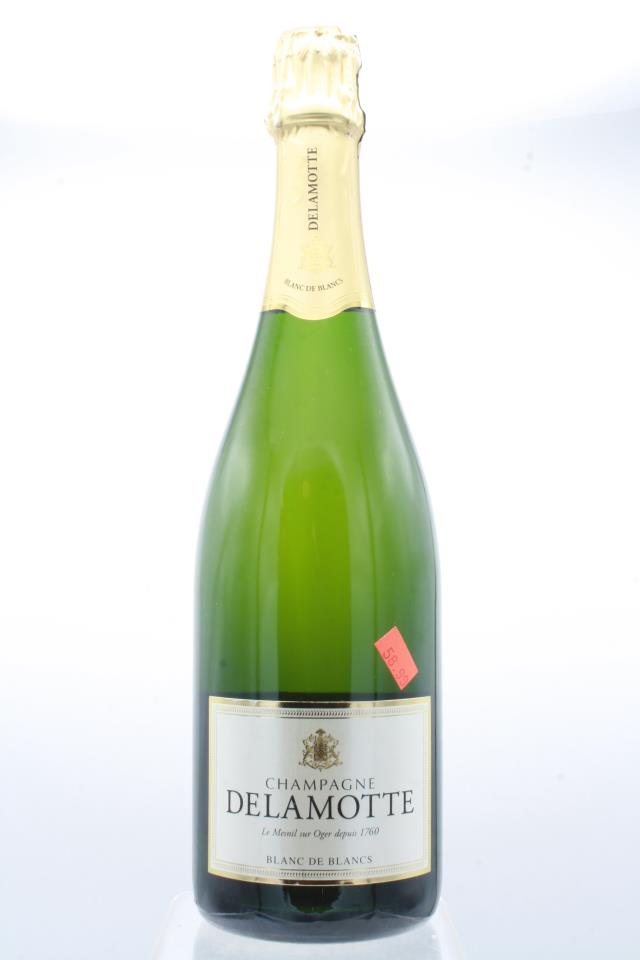 1 / 2
Lot 274
Estimate: $50
2 Lightly scuffed label.
Sold:
This auction has ended. Bidding is closed.
Collection name
Reviews
93WA
". . . the latest rendition of Delamotte's NV Blanc de Blancs is showing just as well as its immediate predecessor, offering up a classy bouquet of crisp green apple, citrus oil, brioche, toasted nuts and dried white flowers. On the palate, the wine is medium to full-bodied, fine-boned and elegant, with a crisp but charming core of fruit, lively acids and a precise, saline finish. Since its acquisition in 1988 by Laurent-Perrier, Delamotte has been twinned with Salon, one of Champagne's most prestigious small houses. Delamotte has both gained and lost by the association: gained, in that some of Salon's reputation has tended to rub off on Delamotte, and lost, because Delamotte is frequently portrayed—though not by the house's team, of course—as something of a "second wine" to Salon. Though both are Chardonnay specialists emphasizing their home village Mesnil-sur-Oger, in reality, the styles are quite distinct. Delamotte's wines undergo malolactic fermentation and, in profile, are creamier, more textural and giving, displaying an elegantly autolytic character while eschewing any extremes of Maillard-derived toastiness. Average production amounts to some 750,000 bottles per year, and the estate's emblematic cuvées are its non-vintage and vintage Blanc de Blancs; the latter especially is a very serious wine, and recent renditions are especially good. In fact, the 2008 may be one of the more underrated wines from this superb vintage on the market, and it's arguably this cuvée that suffers the most by Delamotte's position in Salon's shadow. These wines age well, and old non-vintage Delamotte can be a great bargain in the auction or brokerage market. I'm currently finishing up a case from the early 1980s from my cellar in Burgundy, and every bottle has been terrific."
Region
Sparkling White
Country
Score
". . . the latest rendition of Delamotte's NV Blanc de Blancs is showing just as well as its immediate predecessor, offering up a classy bouquet of crisp green apple, citrus oil, brioche, toasted nuts and dried white flowers. On the palate, the wine is medium to full-bodied, fine-boned and elegant, with a crisp but charming core of fruit, lively acids and a precise, saline finish. Since its acquisition in 1988 by Laurent-Perrier, Delamotte has been twinned with Salon, one of Champagne's most prestigious small houses. Delamotte has both gained and lost by the association: gained, in that some of Salon's reputation has tended to rub off on Delamotte, and lost, because Delamotte is frequently portrayed—though not by the house's team, of course—as something of a "second wine" to Salon. Though both are Chardonnay specialists emphasizing their home village Mesnil-sur-Oger, in reality, the styles are quite distinct. Delamotte's wines undergo malolactic fermentation and, in profile, are creamier, more textural and giving, displaying an elegantly autolytic character while eschewing any extremes of Maillard-derived toastiness. Average production amounts to some 750,000 bottles per year, and the estate's emblematic cuvées are its non-vintage and vintage Blanc de Blancs; the latter especially is a very serious wine, and recent renditions are especially good. In fact, the 2008 may be one of the more underrated wines from this superb vintage on the market, and it's arguably this cuvée that suffers the most by Delamotte's position in Salon's shadow. These wines age well, and old non-vintage Delamotte can be a great bargain in the auction or brokerage market. I'm currently finishing up a case from the early 1980s from my cellar in Burgundy, and every bottle has been terrific."
Have questions?
The world's most influential fine-wine producer and the benchmark for Bordeaux, Burgundy, Champagne and the Rhone. Its appellation (AOC) system codifies geography, grape and method, and its wines set the global standard for age-worthiness and terroir expression.
The northerly region that gives its name to the world's most celebrated sparkling wine, made by secondary fermentation in bottle from Chardonnay, Pinot Noir and Pinot Meunier. Chalky soils and a cool climate yield wines of finesse and longevity.
The sole appellation for true Champagne, producing sparkling wines of finesse and complexity by traditional method from Chardonnay, Pinot Noir and Pinot Meunier.