
Loading lot details…
The September 2022 Auction: Part 1
Swipe left for previous · Swipe right for next
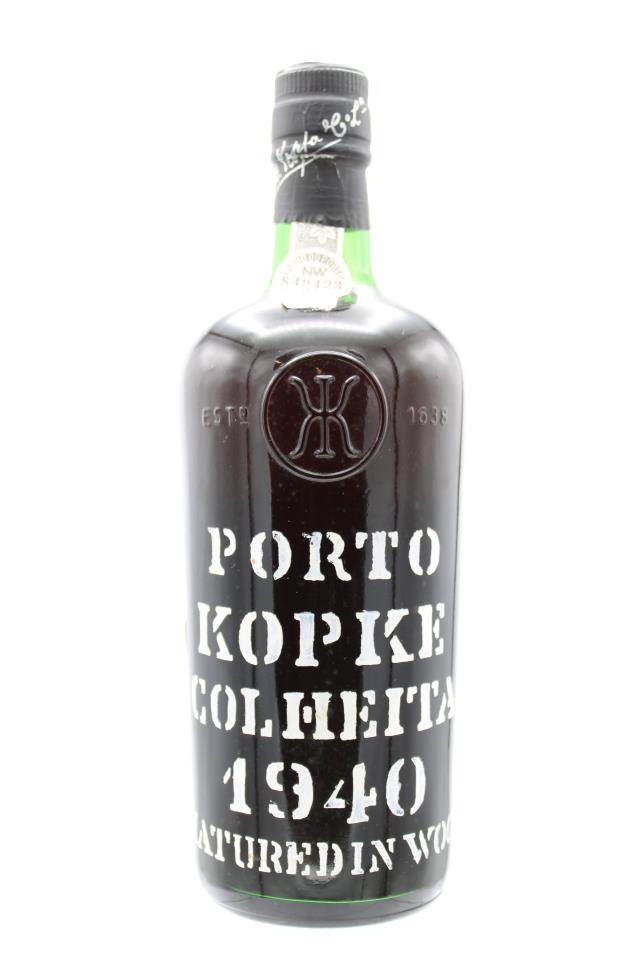 1 / 2
Lot 1555
Estimate: $350
Top shoulder, lightly wrinkled capsule. Bottled in 2000.
Sold:
This auction has ended. Bidding is closed.
Collection name
Reviews
97WA
"The 1940 Colheita Tawny Port is a roughly equal blend of Touriga Nacional, Tinta Roriz, Touriga Franca and Tinta Barroca coming in with 167 grams of residual sugar. This release was bottled in June 2020 with a bar-top cork. Here, we have the outlier in the producer's Tawny submissions this issue. It's not as though the others this issue have no complexity, but this is about being serious. It's intense, multilayered on the finish and all about those "old Tawny" flavors and aromas. There's more molasses here, perhaps even a hint of treacle. To me, that flavor medley and aromatic power is truly the hallmark of great, older Tawnies. It is what you pay for. If you forget to brush your teeth before you go to bed, you will get up in the morning still smelling this. This is also, though, an elegant Tawny with a surprisingly fresh feel, for its age. To be sure, the 1960 is even fresher, and I won't be surprised if some prefer it, but this handles itself well. Overall, it is lovely and something you can drink, not just admire. It's not cracking up and it isn't over the hill. This has its fair share of power too. It does come with a stiff uptick in price, but that's between you and your pocketbook. Pro tip: Tell your significant other you got it for his or her birthday. They will likely let you have a glass or two. Some background: 1940 was the year Kopke was officially recognized as the oldest Port house. The design here and on the 1940 White Colheita is described by the winery this way: "The White Colheita 1940 was launched with the Colheita Tawny 1940 as part of a limited edition. The continuous cycle of the rising and setting of the sun has inspired the concept for this special edition. The 1940 Tawny Colheita has black and white packaging, representing the elegance of the moon, whereas the 1940 White Colheita, with its white and bronze colored packaging, symbolizes the rise and the set of the sun. When joined together, the half-moons depicted on the wines create an eclipse, which metaphorically refers to the eight decades passed until this moment, when we present these wines together." These Colheitas are typically bottled on demand and released at different times. It is required by law, of course, that a release date be on the label. (Here, it's on the back in tiny print.) That date is, of course, referenced in the tasting notes. Don't forget that Tawnies should be drunk cooler than normal—say, 58 to 62 degrees Fahrenheit. They don't need decanting and they are ready to roll on release. Long-aged Tawnies are also very durable when aged in bottle after release—at least if the corks do not fail. The end-date drinking windows are just rough guides. They might go on forever with good corks."
Region
Sweet
Country
Score
"The 1940 Colheita Tawny Port is a roughly equal blend of Touriga Nacional, Tinta Roriz, Touriga Franca and Tinta Barroca coming in with 167 grams of residual sugar. This release was bottled in June 2020 with a bar-top cork. Here, we have the outlier in the producer's Tawny submissions this issue. It's not as though the others this issue have no complexity, but this is about being serious. It's intense, multilayered on the finish and all about those "old Tawny" flavors and aromas. There's more molasses here, perhaps even a hint of treacle. To me, that flavor medley and aromatic power is truly the hallmark of great, older Tawnies. It is what you pay for. If you forget to brush your teeth before you go to bed, you will get up in the morning still smelling this. This is also, though, an elegant Tawny with a surprisingly fresh feel, for its age. To be sure, the 1960 is even fresher, and I won't be surprised if some prefer it, but this handles itself well. Overall, it is lovely and something you can drink, not just admire. It's not cracking up and it isn't over the hill. This has its fair share of power too. It does come with a stiff uptick in price, but that's between you and your pocketbook. Pro tip: Tell your significant other you got it for his or her birthday. They will likely let you have a glass or two. Some background: 1940 was the year Kopke was officially recognized as the oldest Port house. The design here and on the 1940 White Colheita is described by the winery this way: "The White Colheita 1940 was launched with the Colheita Tawny 1940 as part of a limited edition. The continuous cycle of the rising and setting of the sun has inspired the concept for this special edition. The 1940 Tawny Colheita has black and white packaging, representing the elegance of the moon, whereas the 1940 White Colheita, with its white and bronze colored packaging, symbolizes the rise and the set of the sun. When joined together, the half-moons depicted on the wines create an eclipse, which metaphorically refers to the eight decades passed until this moment, when we present these wines together." These Colheitas are typically bottled on demand and released at different times. It is required by law, of course, that a release date be on the label. (Here, it's on the back in tiny print.) That date is, of course, referenced in the tasting notes. Don't forget that Tawnies should be drunk cooler than normal—say, 58 to 62 degrees Fahrenheit. They don't need decanting and they are ready to roll on release. Long-aged Tawnies are also very durable when aged in bottle after release—at least if the corks do not fail. The end-date drinking windows are just rough guides. They might go on forever with good corks."
Have questions?
Best known for fortified Port from the Douro Valley, Portugal also produces distinctive dry reds from native grapes such as Touriga Nacional. Its dramatic terraced vineyards and blending traditions give the wines a singular identity.
One of the world's oldest demarcated wine regions, famed for fortified Port and, increasingly, powerful dry reds. Its terraced schist vineyards and native grapes yield wines of concentration and character.
Covers powerful dry reds and fortified Port from native varieties grown on the valley's terraced schist slopes.
Spain's noble red grape, producing structured, savory wines of red fruit and leather that respond beautifully to oak aging in Rioja and Ribera del Duero.
Portugal's finest red grape, giving deeply colored, floral and structured wines central to both Port and the Douro's dry reds.