
Loading lot details…
The October 2023 Auction: Part 2
Swipe left for previous · Swipe right for next
 1 / 2
Lot 465
Estimate: $650
Very lightly wrinkled capsules.
Sold:
This auction has ended. Bidding is closed.
Collection name
Reviews
94WA
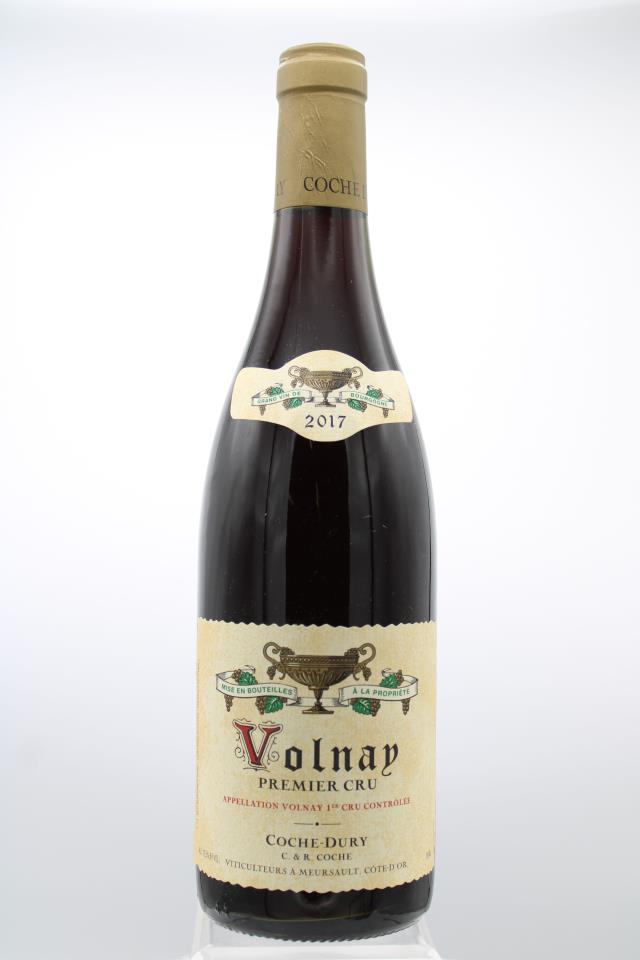
"The 2017 Volnay 1er Cru is a blend of Taillepieds and Clos des Chênes, and it is showing brilliantly, offering up a deep bouquet of ripe wild berries, dark chocolate, rich soil tones, spices and peonies. On the palate, the wine is medium to full-bodied, layered and concentrated, with a more reserved profile than the Domaine's other reds this year, its deep core of sapid fruit framed by powdery tannins and lively acids. As I wrote last year, recent vintages have witnessed a stylistic evolution at Domaine Coche-Dury. In Raphaël Coche's words, the domaine now works with ‘less new oak, less bâtonnage and less heavy lees.’ The distinctively toasty, sometimes reductive signature that marked out the Coche-Dury wines of yesteryear is less pronounced. But, as Raphaël emphasizes, that has been the case for some time. ‘The last vintages marked by pronounced reduction were 1999 and 2007,’ he observes. ‘And I didn't initiate the move toward a purer, less stylized approach alone: my father and I agreed on the change of direction together.’ Some clients, Raphaël says, have complained, but his response is uncompromising. ‘They may want the vinification [techniques] in the glass, but I want to taste the terroir.’ The fundamentals of Domaine Coche-Dury's greatness, as I emphasized last year, remain the same: high-quality viticulture, a rare aptitude—which seems to have been passed down from father to son—for knowing how hard to press and for how long, careful choice of barrels and long, patient and meticulously supervised fermentations and élevage. The wines continue to be distinguished by their incisive acids, striking intensity and frequently appreciable presence of dry extract—the latter is something Raphaël argues can bring structure and freshness to wines from the warm vintages that Burgundy is witnessing more and more frequently. There isn't a Coche formula, rather there is a Coche palate, for decisions are made by tasting. ‘When my grandfather used to say winemaking was an art, sometimes I wondered what he had been smoking, but more and more I agree—it's all a question of feeling,’ says Raphaël. Jean-François, I should add, is also very much a continuing presence at the domaine. ‘My father comes by every day and gives his opinion,’ Raphaël confirms. On my latest visit to the domaine, I took the opportunity to discuss a few other developments with Raphaël. The first is that the estate's labels now read simply ‘Coche-Dury,’ an acknowledgement that, for certain cuvées, Raphaël is prepared to purchase grapes to supplement his production. ‘If I don't want to have an accountant telling me what to do, I need to produce a certain number of bottles per year. In a year when crops are small, such as 2016, I would rather purchase some high-quality grapes than cut any corners in the cellar to improve cash flow,’ he explained with candor. ‘The day I'm not able to make my wines exactly the way I want to, to my own standards, is the day when I'll change professions,’ he emphasizes. In other words, a little négociant activity chez Coche-Dury—itself not without precedent—is about running a healthy and independent business. The second is that Raphaël has acquired a custom bottling line. ‘I have been looking into it for a decade, but for a long time I wasn't satisfied with the available technology.’ Readers may remember that Coche-Dury has long been a hold-out for bottling direct from the barrel, with a two-headed spigot known as a ‘chèvre à deux becs.’ ‘I really wanted to find a system that gave just as good a result as the chèvre,’ he continues, ‘which means bottling by gravity, with only a very small gradient between the bottle and the wine.’ After years of research and trials, Raphaël has finally found a system that meets his criteria. ‘I remain a partisan of the chèvre,’ he notes, ‘and two-thirds of the production is still bottled by hand that way.’ So, commentators who claim the domaine has entirely abandoned the old system are very much mistaken. ‘But the new system in some respects gives an even better result,’ he explains. ‘The barrels are assembled before bottling to make an homogenous blend, and the bottles are properly washed.’ The thoughtfulness with which Coche has approached this subject is typical of the attention to detail he brings to every aspect of the winemaking process. And what of the wines? The Coche-Dury 2017s showed brilliantly and number among the vintage's finest. Beautifully balanced and incisive, this is an elegantly charming vintage chez Coche that should offer a broad drinking window, showing well young but with the structure and cut to age for decades. Indeed, both the Meursault Perrières and Corton-Charlemagne reviewed here won't be released for years. The only challenge will be finding a few bottles, but anyone who manages to do so will possess some of the very finest wines France has to offer, from one of its admirable wine-producing families."
Region
Red
Country
Score
"The 2017 Volnay 1er Cru is a blend of Taillepieds and Clos des Chênes, and it is showing brilliantly, offering up a deep bouquet of ripe wild berries, dark chocolate, rich soil tones, spices and peonies. On the palate, the wine is medium to full-bodied, layered and concentrated, with a more reserved profile than the Domaine's other reds this year, its deep core of sapid fruit framed by powdery tannins and lively acids. As I wrote last year, recent vintages have witnessed a stylistic evolution at Domaine Coche-Dury. In Raphaël Coche's words, the domaine now works with ‘less new oak, less bâtonnage and less heavy lees.’ The distinctively toasty, sometimes reductive signature that marked out the Coche-Dury wines of yesteryear is less pronounced. But, as Raphaël emphasizes, that has been the case for some time. ‘The last vintages marked by pronounced reduction were 1999 and 2007,’ he observes. ‘And I didn't initiate the move toward a purer, less stylized approach alone: my father and I agreed on the change of direction together.’ Some clients, Raphaël says, have complained, but his response is uncompromising. ‘They may want the vinification [techniques] in the glass, but I want to taste the terroir.’ The fundamentals of Domaine Coche-Dury's greatness, as I emphasized last year, remain the same: high-quality viticulture, a rare aptitude—which seems to have been passed down from father to son—for knowing how hard to press and for how long, careful choice of barrels and long, patient and meticulously supervised fermentations and élevage. The wines continue to be distinguished by their incisive acids, striking intensity and frequently appreciable presence of dry extract—the latter is something Raphaël argues can bring structure and freshness to wines from the warm vintages that Burgundy is witnessing more and more frequently. There isn't a Coche formula, rather there is a Coche palate, for decisions are made by tasting. ‘When my grandfather used to say winemaking was an art, sometimes I wondered what he had been smoking, but more and more I agree—it's all a question of feeling,’ says Raphaël. Jean-François, I should add, is also very much a continuing presence at the domaine. ‘My father comes by every day and gives his opinion,’ Raphaël confirms. On my latest visit to the domaine, I took the opportunity to discuss a few other developments with Raphaël. The first is that the estate's labels now read simply ‘Coche-Dury,’ an acknowledgement that, for certain cuvées, Raphaël is prepared to purchase grapes to supplement his production. ‘If I don't want to have an accountant telling me what to do, I need to produce a certain number of bottles per year. In a year when crops are small, such as 2016, I would rather purchase some high-quality grapes than cut any corners in the cellar to improve cash flow,’ he explained with candor. ‘The day I'm not able to make my wines exactly the way I want to, to my own standards, is the day when I'll change professions,’ he emphasizes. In other words, a little négociant activity chez Coche-Dury—itself not without precedent—is about running a healthy and independent business. The second is that Raphaël has acquired a custom bottling line. ‘I have been looking into it for a decade, but for a long time I wasn't satisfied with the available technology.’ Readers may remember that Coche-Dury has long been a hold-out for bottling direct from the barrel, with a two-headed spigot known as a ‘chèvre à deux becs.’ ‘I really wanted to find a system that gave just as good a result as the chèvre,’ he continues, ‘which means bottling by gravity, with only a very small gradient between the bottle and the wine.’ After years of research and trials, Raphaël has finally found a system that meets his criteria. ‘I remain a partisan of the chèvre,’ he notes, ‘and two-thirds of the production is still bottled by hand that way.’ So, commentators who claim the domaine has entirely abandoned the old system are very much mistaken. ‘But the new system in some respects gives an even better result,’ he explains. ‘The barrels are assembled before bottling to make an homogenous blend, and the bottles are properly washed.’ The thoughtfulness with which Coche has approached this subject is typical of the attention to detail he brings to every aspect of the winemaking process. And what of the wines? The Coche-Dury 2017s showed brilliantly and number among the vintage's finest. Beautifully balanced and incisive, this is an elegantly charming vintage chez Coche that should offer a broad drinking window, showing well young but with the structure and cut to age for decades. Indeed, both the Meursault Perrières and Corton-Charlemagne reviewed here won't be released for years. The only challenge will be finding a few bottles, but anyone who manages to do so will possess some of the very finest wines France has to offer, from one of its admirable wine-producing families."
Have questions?
The world's most influential fine-wine producer and the benchmark for Bordeaux, Burgundy, Champagne and the Rhone. Its appellation (AOC) system codifies geography, grape and method, and its wines set the global standard for age-worthiness and terroir expression.
Produces the world's most revered Pinot Noir and Chardonnay from a mosaic of tiny, terroir-defined climats. Its hierarchy of village, Premier Cru and Grand Cru vineyards makes site the ultimate expression of quality.
Volnay is a village AOC in Burgundy's Cote de Beaune with esteemed Premier Crus, producing elegant, perfumed and silky Pinot Noir reds prized for their finesse, delicacy and floral red-fruit character.
2017 in Burgundy delivered generous yields and fresh, elegant wines; the whites are especially fine, bright and precise, while the reds are charming, supple and aromatic, drinking well relatively early.
A thin-skinned, terroir-sensitive red producing perfumed, silky and elegant wines of red-berry fruit and earthy complexity. It reaches its apogee in Burgundy.