
Loading lot details…
The November 2026 Auction: Part 1
Swipe left for previous · Swipe right for next
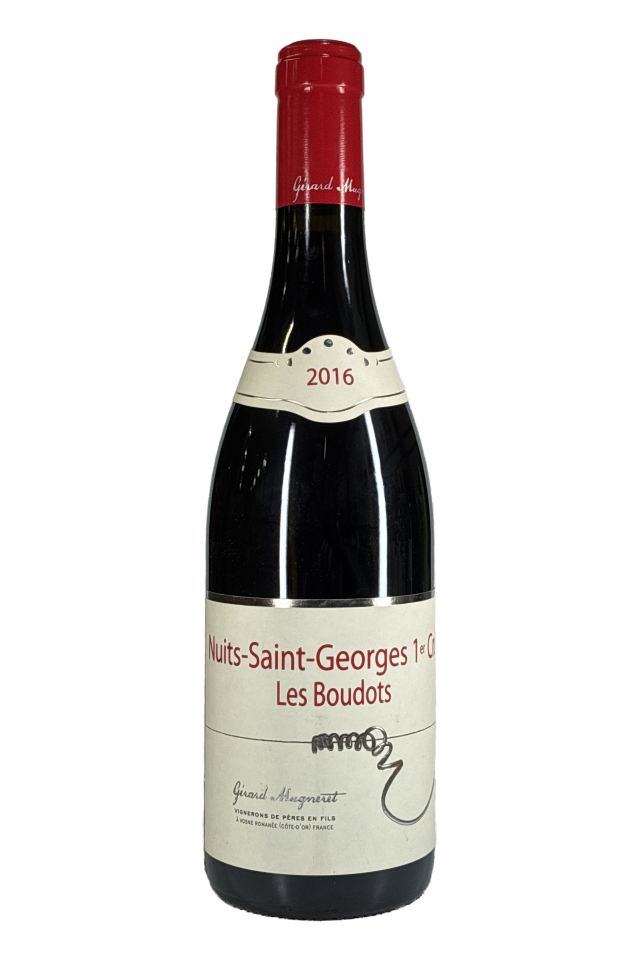 1 / 2
Lot 157
Estimate: $140
Very lightly scuffed label.
Sold:
This auction has ended. Bidding is closed.
Collection name
Reviews
92-93ST
"(40% vendange entier; 33% new oak): Medium-deep red. Plummier and richer on the nose than the Suchots but with excellent lift to the aromas of black raspberry, spices and violet. Deeply pitched, rich and plump, conveying an impression of brooding power but quite dry and restrained today, perhaps a bit dominated in the early going by its mineral element. Finishes with firm, slowly building tannins and lovely breadth and depth. A repeating violet quality adds lift. Pascal Mugneret, who was an engineer before returning to his family’s seven-hectare estate and eventually taking over winemaking duties from his father Gérard with vintage 2005, applies a scientist’s approach to viticulture and vinification. He keeps charts on all of his wines, including details about their vinification. But he made clear to me that he’s not a revolutionary. ‘We don’t discover things; we reveal things that have been forgotten.’ Mugneret started harvesting in 2016 on September 22, noting that he prefers to have more freshness ‘even at the expense of a bit less concentration and phenolic maturity.’ The estate lost 40% of its normal production in '16, mostly due to the frost. Potential alcohol levels were around 12.5% and Mugneret chaptalized by only about 0.3 degree. The malos finished early, in December of ‘16, and that explains why some ‘16s had been bottled by the time of my January visit, while others were in vats (his Vosne Suchots, Nuits Boudots and Echézeaux were still in fûts). Mugneret does not do a pre-fermentation cold soak because he vinifies with a portion of whole clusters (he only started using vendange entier in 2012, which he believes ‘will allow his wines to age more harmoniously, assuming the stems are ripe, of course’) and makes his wines with low levels of SO2; nor does he believe in further maceration after the fermentations have finished. He ages his wines in 25% to 50% new oak and only pumps his wines once—from small tanks into the larger vats he uses for bottling—but he’s building an addition to his winery so that he can carry out even this final step by gravity. He has recently switched to a denser, wider, longer cork with a ‘mirror face’ on one end—a side with no physical defects. As it provides a perfect surface, it helps Mugneret preserve the purity of his low-sulfur wines. But it's an added expense, as Mugneret must manually orient the corks prior to bottling to make sure that it’s the polished end that’s in contact with the wine. Mugneret also told me about a technique called crystallization sensible, which was originally discovered by Rudolf Steiner in the early 20th century and that he began using in 2017 as ‘another way to see wines, because analysis and tastings are not enough.’ One of the leading practitioners of crystallization sensible in France today is enologist Margarethe Chapelle and her laboratory, Oenocristal. She begins with drops of various wines, putting them in a copper chlorate solution. They are crystallized by evaporation, and the shape of the crystals can provide a lot of information about what Mugneret described as ‘the vibrating state of the wine,’ including its susceptibility to brettanomyces and its ability to resist oxidation. In fact, he actually showed me ‘pictures’ of the crystals formed by his various wines. As for his 2015s, Mugneret said that 2016 is more his style. He believes that the warmest years are better for Burgundy’s regional wines and less interesting for the crus. He’s not keen on past hot vintages like 2003, 2005 and 2009 and feels that ‘it’s okay if the ‘15s are more austere,’ by which I assume he means that this is a positive sign for these wines. He emphasized that he doesn’t pay a lot of attention to huge concentration, noting that a wine ages more on its acidity and balance. Mugneret cited Romanée-Conti as a wine that evolves for decades on its perfect harmony, not its power, as long as it has sufficient concentration."
Region
Red
Country
Score
"(40% vendange entier; 33% new oak): Medium-deep red. Plummier and richer on the nose than the Suchots but with excellent lift to the aromas of black raspberry, spices and violet. Deeply pitched, rich and plump, conveying an impression of brooding power but quite dry and restrained today, perhaps a bit dominated in the early going by its mineral element. Finishes with firm, slowly building tannins and lovely breadth and depth. A repeating violet quality adds lift. Pascal Mugneret, who was an engineer before returning to his family’s seven-hectare estate and eventually taking over winemaking duties from his father Gérard with vintage 2005, applies a scientist’s approach to viticulture and vinification. He keeps charts on all of his wines, including details about their vinification. But he made clear to me that he’s not a revolutionary. ‘We don’t discover things; we reveal things that have been forgotten.’ Mugneret started harvesting in 2016 on September 22, noting that he prefers to have more freshness ‘even at the expense of a bit less concentration and phenolic maturity.’ The estate lost 40% of its normal production in '16, mostly due to the frost. Potential alcohol levels were around 12.5% and Mugneret chaptalized by only about 0.3 degree. The malos finished early, in December of ‘16, and that explains why some ‘16s had been bottled by the time of my January visit, while others were in vats (his Vosne Suchots, Nuits Boudots and Echézeaux were still in fûts). Mugneret does not do a pre-fermentation cold soak because he vinifies with a portion of whole clusters (he only started using vendange entier in 2012, which he believes ‘will allow his wines to age more harmoniously, assuming the stems are ripe, of course’) and makes his wines with low levels of SO2; nor does he believe in further maceration after the fermentations have finished. He ages his wines in 25% to 50% new oak and only pumps his wines once—from small tanks into the larger vats he uses for bottling—but he’s building an addition to his winery so that he can carry out even this final step by gravity. He has recently switched to a denser, wider, longer cork with a ‘mirror face’ on one end—a side with no physical defects. As it provides a perfect surface, it helps Mugneret preserve the purity of his low-sulfur wines. But it's an added expense, as Mugneret must manually orient the corks prior to bottling to make sure that it’s the polished end that’s in contact with the wine. Mugneret also told me about a technique called crystallization sensible, which was originally discovered by Rudolf Steiner in the early 20th century and that he began using in 2017 as ‘another way to see wines, because analysis and tastings are not enough.’ One of the leading practitioners of crystallization sensible in France today is enologist Margarethe Chapelle and her laboratory, Oenocristal. She begins with drops of various wines, putting them in a copper chlorate solution. They are crystallized by evaporation, and the shape of the crystals can provide a lot of information about what Mugneret described as ‘the vibrating state of the wine,’ including its susceptibility to brettanomyces and its ability to resist oxidation. In fact, he actually showed me ‘pictures’ of the crystals formed by his various wines. As for his 2015s, Mugneret said that 2016 is more his style. He believes that the warmest years are better for Burgundy’s regional wines and less interesting for the crus. He’s not keen on past hot vintages like 2003, 2005 and 2009 and feels that ‘it’s okay if the ‘15s are more austere,’ by which I assume he means that this is a positive sign for these wines. He emphasized that he doesn’t pay a lot of attention to huge concentration, noting that a wine ages more on its acidity and balance. Mugneret cited Romanée-Conti as a wine that evolves for decades on its perfect harmony, not its power, as long as it has sufficient concentration."
Have questions?
French wine covers a remarkable range of styles, from the structured reds of Bordeaux to the sparkling wines of Champagne, where a second fermentation in the bottle creates the bubbles. Bordeaux is best known for red blends built around Cabernet Sauvignon or Merlot, but it also makes dry whites and the sweet wines of Sauternes. Burgundy is a benchmark for Pinot Noir and Chardonnay, with wines that can taste distinctly different from one village to the next. The Rhône Valley offers a contrast within a single region: Syrah shapes the reds of the north, while Grenache often leads the blends of the south. In the Loire Valley, Chenin Blanc can be dry, sweet or sparkling, while Cabernet Franc is the signature red grape of appellations such as Chinon and Saumur-Champigny. A French wine label often starts with a place name. The Appellation d’Origine Contrôlée (AOC) identifies a defined area and sets rules for permitted grapes and production. Learning a few appellation names makes it easier to recognize the styles you enjoy and find related wines from neighboring villages or other producers.
Burgundy, or Bourgogne, is best known for Pinot Noir and Chardonnay. A useful way to explore the region is to follow one grape across several places. Chablis shows Chardonnay’s brisk, citrus and mineral side, while Meursault and Puligny-Montrachet in the Côte de Beaune offer a contrast in texture and richness. In the Côte de Nuits, villages such as Gevrey-Chambertin and Vosne-Romanée are closely associated with Pinot Noir. Farther south, look to Mercurey in the Côte Chalonnaise for Pinot Noir and to Pouilly-Fuissé in the Mâconnais for Chardonnay. Burgundy’s labels tell you how precisely the wine’s origin is defined. A regional appellation can cover a broad area, while a village wine comes from a more narrowly defined area around a named commune. Premier Cru identifies designated vineyard sites within a village appellation, and Grand Cru sites have appellations of their own. These named vineyard parcels, known as climats, can differ in soil, slope and exposure even when they sit side by side. To get a feel for those differences, compare two villages from the same producer and vintage, or try two producers working in the same vineyard. Both comparisons help show how place and winemaking shape the wine in your glass.
Pinot Noir is a thin-skinned red grape celebrated for aromatic detail, silky texture and sensitivity to its growing site. Cherry and strawberry are familiar flavors, often accompanied by floral notes and, with maturity, earthy or forest-floor complexity. Its wines are commonly light to medium in body, with freshness and fine tannins that can give a sense of delicacy alongside considerable depth. Burgundy is Pinot Noir's historic home and a benchmark for the grape. There, differences in soil, slope and exposure can produce distinct expressions from neighboring vineyards, making Pinot Noir central to the region's emphasis on terroir. Beyond Burgundy, cooler growing regions have developed their own interpretations, including Australia's Yarra Valley, Mornington Peninsula and Tasmania. Pinot Noir can produce fresh, fruit-focused wines for earlier enjoyment as well as more structured examples that gain complexity with age. Vineyard conditions and choices in fermentation and oak aging influence its balance of perfume, fruit and savory character. Its appeal lies in nuance and the way a single grape can communicate the individuality of a place.