
Loading lot details…
The November 2026 Auction: Part 2
Swipe left for previous · Swipe right for next
 1 / 2
Lot 71
Estimate: $250
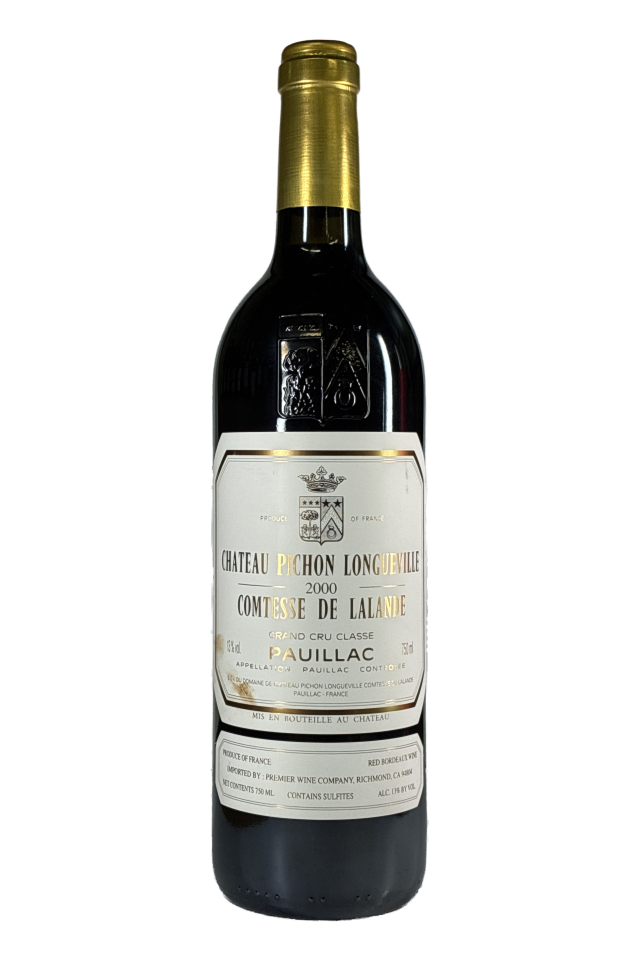
Lightly bin soiled label.
Next Bid
Current Bid
Sign in to place bids and add to your watchlist.
Login to BidCollection name
Reviews
97RP
"The 2000 Pichon-Longueville Comtesse de Lalande is spectacular, and certainly a noteworthy rival to the 1996, 1995, and even the extraordinary 1982. A blend of 50% Cabernet Sauvignon, 34% Merlot, 10% Petit Verdot, and the rest Cabernet Franc, this effort has a dense saturated purple color, a singular/distinctive yet possibly controversial aromatic smorgasbord existing of creme de cassis, vanilla, and violets, but also tapenade and tree bark. No doubt the Petit Verdot has imparted a certain almost olive-like component to the wine's aromatic profile. In the mouth, it is a wine of extraordinary density, opulence, great presence, and richness. As the 2000 sits in the glass, notes of lavender and melted licorice emerge along with the distinctive tapenade aromas interwoven with creme de cassis, espresso roast, and cedar. The wine is full-bodied, with extraordinary purity and a tremendous texture. I suspect this wine will be relatively approachable young but evolve effortlessly. This is a dramatic, almost flamboyant style that is not classic Pauillac in one sense, but a classic wine."
Region
Red
Country
Score
"The 2000 Pichon-Longueville Comtesse de Lalande is spectacular, and certainly a noteworthy rival to the 1996, 1995, and even the extraordinary 1982. A blend of 50% Cabernet Sauvignon, 34% Merlot, 10% Petit Verdot, and the rest Cabernet Franc, this effort has a dense saturated purple color, a singular/distinctive yet possibly controversial aromatic smorgasbord existing of creme de cassis, vanilla, and violets, but also tapenade and tree bark. No doubt the Petit Verdot has imparted a certain almost olive-like component to the wine's aromatic profile. In the mouth, it is a wine of extraordinary density, opulence, great presence, and richness. As the 2000 sits in the glass, notes of lavender and melted licorice emerge along with the distinctive tapenade aromas interwoven with creme de cassis, espresso roast, and cedar. The wine is full-bodied, with extraordinary purity and a tremendous texture. I suspect this wine will be relatively approachable young but evolve effortlessly. This is a dramatic, almost flamboyant style that is not classic Pauillac in one sense, but a classic wine."
Have questions?
The world's most influential fine-wine producer and the benchmark for Bordeaux, Burgundy, Champagne and the Rhone. Its appellation (AOC) system codifies geography, grape and method, and its wines set the global standard for age-worthiness and terroir expression.
The world's largest fine-wine region, built around blends of Cabernet Sauvignon and Merlot. Divided by the Gironde estuary into the structured Left Bank and the plush, Merlot-led Right Bank, it is the historic benchmark for age-worthy claret and sweet Sauternes.
Home to three of Bordeaux's five First Growths, Pauillac is the Left Bank benchmark for powerful, structured Cabernet Sauvignon. Its wines are famed for cassis, cedar and graphite notes and exceptional aging potential.
Cabernet Sauvignon is a red grape known for deep color, firm tannins and a clearly defined structure. Blackcurrant, often described as cassis, is a signature flavor, accompanied by blackberry and, depending on the wine, cedar, graphite, mint or herbal notes. Oak aging can add spice and toast, while bottle age may bring tobacco, leather and other savory layers. The grape is a cornerstone of Bordeaux's Left Bank, especially the Médoc and Graves, where it is commonly blended with Merlot, Cabernet Franc and smaller amounts of other varieties. Beyond Bordeaux, Cabernet Sauvignon has established distinctive regional identities, including Australia's Coonawarra and Margaret River. Vineyard climate and ripeness influence whether the emphasis falls on fresh fruit and herbs or richer, fuller expressions. Its tannins, acidity and concentration can support long development in well-balanced examples. Many accessible styles are made for earlier enjoyment, while more structured wines reward time as their tannins soften and their aromas evolve. Cabernet Sauvignon brings depth and backbone to blends and can also express a vineyard's character as a varietal wine.