
Loading lot details…
The November 2026 Auction: Part 2
Swipe left for previous · Swipe right for next
 1 / 2
Lot 1034
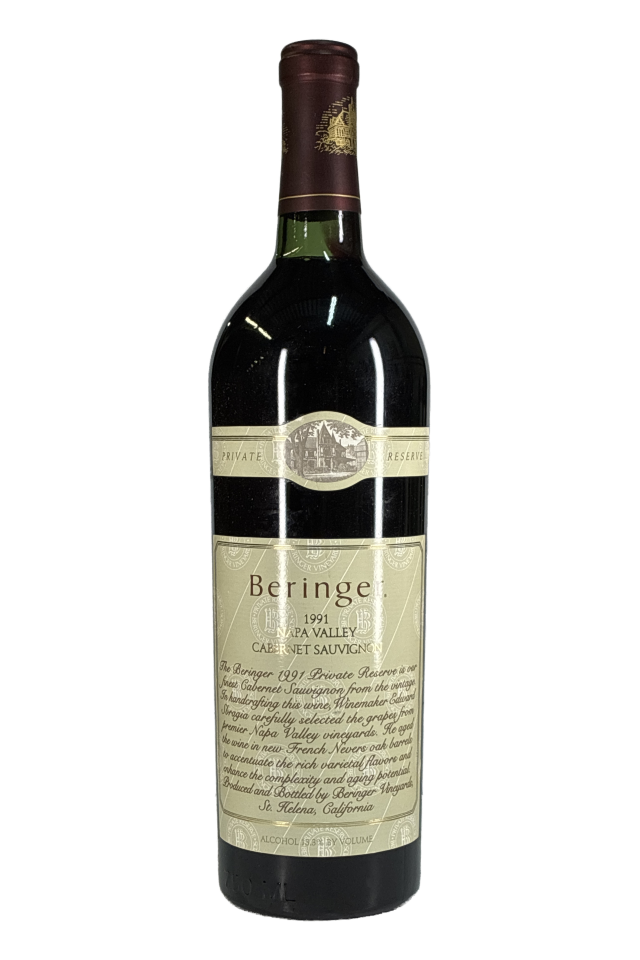
Estimate: $140
Very top shoulder.
Next Bid
Opening Bid
Sign in to place bids and add to your watchlist.
Login to BidCollection name
Reviews
96RP
"Blend: 97% Cabernet Sauvignon and 3% Cabernet Franc; Harvest Dates: October 12 - November 11 The second largest production of Beringer’s Private Reserve, the 1991 came in just behind the 24,000 cases of the 1997. Interestingly, these are among the greatest Private Reserves made, and as Ed Sbragia told me, it was just one of those perfect vintages. One of the longest and coolest growing seasons in the history of California, it was marked by cool temperatures throughout the summer and a perfect Indian Summer. The hang time of the grapes, ranging from the date of flowering to the date of harvest, was historically long (I do not believe it has been equaled since). The Cabernet Sauvignon came from the same three sources as the 1990, Bancroft Ranch, the Home Vineyard in St. Helena, and Chabot Vineyard, and the tiny dollop of Cabernet Franc was from the Bancroft Ranch site. I’ve enjoyed many bottles of this spectacular effort, which still possesses a dense ruby/purple color as well as a sumptuous nose of spring flowers, graphite, loamy soil, creme de cassis, black cherries and blackberries. With sweet tannin, a full-bodied mouthfeel and incredible purity as well as youthfulness, this wine has another 15-20 years of life left in it. If this were a Bordeaux, one would think it was 8-10 years old, not two decades. There are no hard edges, and the seamless integration of all the component parts make it one of the prodigious Beringer Cabernet Sauvignon Private Reserves . . ."
Region
Red
Country
Score
"Blend: 97% Cabernet Sauvignon and 3% Cabernet Franc; Harvest Dates: October 12 - November 11 The second largest production of Beringer’s Private Reserve, the 1991 came in just behind the 24,000 cases of the 1997. Interestingly, these are among the greatest Private Reserves made, and as Ed Sbragia told me, it was just one of those perfect vintages. One of the longest and coolest growing seasons in the history of California, it was marked by cool temperatures throughout the summer and a perfect Indian Summer. The hang time of the grapes, ranging from the date of flowering to the date of harvest, was historically long (I do not believe it has been equaled since). The Cabernet Sauvignon came from the same three sources as the 1990, Bancroft Ranch, the Home Vineyard in St. Helena, and Chabot Vineyard, and the tiny dollop of Cabernet Franc was from the Bancroft Ranch site. I’ve enjoyed many bottles of this spectacular effort, which still possesses a dense ruby/purple color as well as a sumptuous nose of spring flowers, graphite, loamy soil, creme de cassis, black cherries and blackberries. With sweet tannin, a full-bodied mouthfeel and incredible purity as well as youthfulness, this wine has another 15-20 years of life left in it. If this were a Bordeaux, one would think it was 8-10 years old, not two decades. There are no hard edges, and the seamless integration of all the component parts make it one of the prodigious Beringer Cabernet Sauvignon Private Reserves . . ."
Have questions?
The fourth-largest wine producer in the world, led by California. American fine wine is defined by ripe, expressive fruit and a spirit of innovation, with Napa Valley Cabernet Sauvignon among the most sought-after wines globally.
California's most prestigious wine region, celebrated worldwide for opulent, structured Cabernet Sauvignon. Diverse soils and mountain-to-valley-floor sites yield wines of remarkable ripeness, power and longevity.
California's flagship appellation for opulent, structured Cabernet Sauvignon of ripe fruit, plush tannins and cellar-worthy depth.
Cabernet Franc is an aromatic red grape prized for its perfume, freshness and savory character. Raspberry and violet are familiar notes, often joined by red fruit, herbs and a leafy edge. Its wines can be supple and fragrant or more firmly structured, with the balance of fruit, tannin and herbal complexity shaped by ripeness, vineyard site and winemaking. In France's Loire Valley, Cabernet Franc often takes center stage in wines from Chinon, Bourgueil, Saint-Nicolas-de-Bourgueil and Saumur-Champigny. These expressions highlight the grape's ability to reflect differences between vineyards while retaining a distinctive sense of freshness. In Bordeaux, particularly Saint-Émilion, it is an important partner to Merlot and Cabernet Sauvignon, contributing aromatic lift, finesse and structure. Cabernet Franc generally ripens before Cabernet Sauvignon and produces wines ranging from lively, fruit-focused bottlings to concentrated examples capable of developing additional complexity with age. Its appeal lies in the interplay of fruit, floral perfume and savory detail, whether bottled on its own or used to bring nuance to a blend.
Cabernet Sauvignon is a red grape known for deep color, firm tannins and a clearly defined structure. Blackcurrant, often described as cassis, is a signature flavor, accompanied by blackberry and, depending on the wine, cedar, graphite, mint or herbal notes. Oak aging can add spice and toast, while bottle age may bring tobacco, leather and other savory layers. The grape is a cornerstone of Bordeaux's Left Bank, especially the Médoc and Graves, where it is commonly blended with Merlot, Cabernet Franc and smaller amounts of other varieties. Beyond Bordeaux, Cabernet Sauvignon has established distinctive regional identities, including Australia's Coonawarra and Margaret River. Vineyard climate and ripeness influence whether the emphasis falls on fresh fruit and herbs or richer, fuller expressions. Its tannins, acidity and concentration can support long development in well-balanced examples. Many accessible styles are made for earlier enjoyment, while more structured wines reward time as their tannins soften and their aromas evolve. Cabernet Sauvignon brings depth and backbone to blends and can also express a vineyard's character as a varietal wine.