
Loading lot details…
The November 2026 Auction: Part 3
Swipe left for previous · Swipe right for next
 1 / 2
Lot 1877
Estimate: $100
Next Bid
Current Bid
Sign in to place bids and add to your watchlist.
Login to BidCollection name
Reviews
98VM
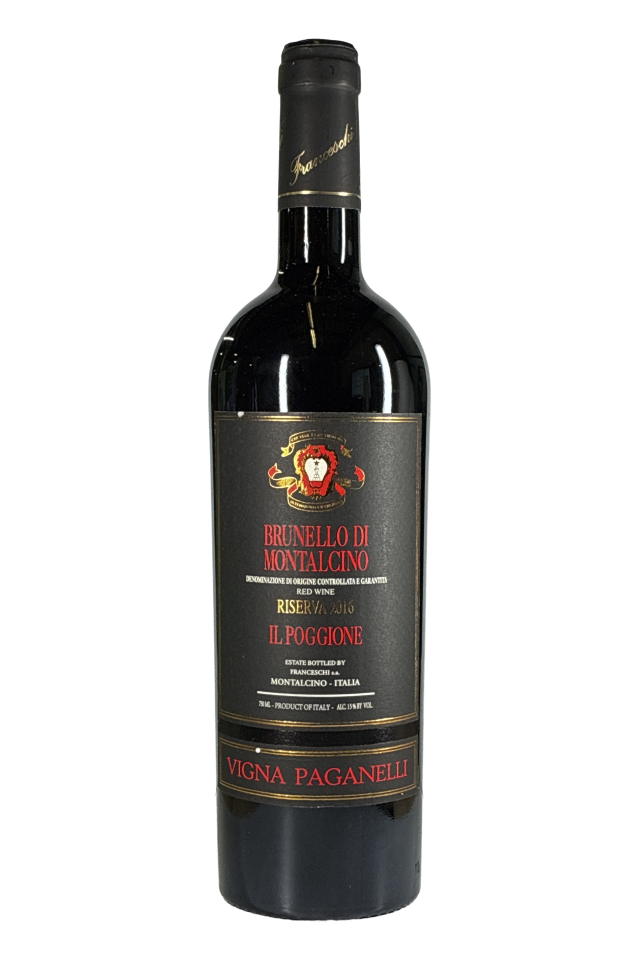
"A beguiling mix of camphor and minty herbs, along with crushed stone, blows off slowly to reveal dark depths of black raspberry, licorice, autumnal spice and worn leather as the 2016 Brunello di Montalcino Riserva Vigna Paganelli unfolds in the glass. Its textures are unexpectedly soft and velvety-smooth, coupled with depths of intense red fruits that make an appearance just before a mix of brisk acids and tannins creates a more tactile and youthfully clenching expression toward the finale. This leaves the palate aching under the 2016’s structural heft, yet with plenty of primary concentration to balance, as wild savory herbs and earthy mineral tones linger for up to a minute. The potential here is off the charts, but readers will need to be very patient. The Riserva Vigna Paganelli is a cru selection of old vines that refines for 48 months in large French oak barrels of 33–52 hectoliters. Touring the vineyards of Il Poggione with Fabrizio and Alessandro Bindocci during a long dry spell in July of 2021 was eye-opening to show how well these old vines could remain healthy through such hot and parched conditions. The canopies were full and vibrant, thriving in the calcareous clay soils that these vines are planted in. Like most producers in Sant’Angelo in Colle, Il Poggione will use emergency irrigation, but only if necessary. At that time (July 2021), it was not even being considered; but in a vintage like 2017, it was necessary. Granted, what Il Poggione also has going for them is the health and age of their vines, the biodiversity of the property, and higher elevations (up to 450 meters) that help to balance the heat. The massive Il Poggione holdings encompass 600 hectares of land, of which only 125 are planted to vines, and 70 with olive groves. To this day, and even at that size, harvest continues to be done by hand. During the torrid 2017 vintage, that harvest was also done earlier, starting September 1st, in an attempt to maintain acidity and prevent the grapes from shriveling on the vines; as a result, the winery needed to be incredibly strict with their selection, and go as far as removing seeds during the early parts of the fermentation process. As is always the case, Il Poggione vinifies all of their parcels separately, refining in large French oak casks, which gives them the ability to blend fruit from young vines to old, and lower elevations to high, in order to create the most balanced expression of each vintage. In the case of 2017, that meant adding all of the old-vine fruit from Vigna Paganelli. In the end, production may be down by 15%, but what they created is an atypical expression of the vintage. Speaking of Vigna Paganelli, the 2016 may just be the greatest rendition of this wine that I’ve yet encountered. The Riserva is a selection from within the Paganelli vineyard, which was planted in 1964. A second selection then takes place at the winery, prior to crush, fermentation and a long refinement of forty-eight months in large French oak barrels between thirty-three to fifty-two hectoliters. This is a wine that will require a lot of patience from collectors, as today it is tightly wound yet densely packed with fruit and teeming with unbridled energy. While at the winery, I was able to taste a 1967 Riserva with Alessandro Bindocci, which resolidifies the staying power of these wines. In the end, we collect Il Poggione Brunello with the long game in mind--but it’s a game worth playing."
Region
Red
Country
Score
"A beguiling mix of camphor and minty herbs, along with crushed stone, blows off slowly to reveal dark depths of black raspberry, licorice, autumnal spice and worn leather as the 2016 Brunello di Montalcino Riserva Vigna Paganelli unfolds in the glass. Its textures are unexpectedly soft and velvety-smooth, coupled with depths of intense red fruits that make an appearance just before a mix of brisk acids and tannins creates a more tactile and youthfully clenching expression toward the finale. This leaves the palate aching under the 2016’s structural heft, yet with plenty of primary concentration to balance, as wild savory herbs and earthy mineral tones linger for up to a minute. The potential here is off the charts, but readers will need to be very patient. The Riserva Vigna Paganelli is a cru selection of old vines that refines for 48 months in large French oak barrels of 33–52 hectoliters. Touring the vineyards of Il Poggione with Fabrizio and Alessandro Bindocci during a long dry spell in July of 2021 was eye-opening to show how well these old vines could remain healthy through such hot and parched conditions. The canopies were full and vibrant, thriving in the calcareous clay soils that these vines are planted in. Like most producers in Sant’Angelo in Colle, Il Poggione will use emergency irrigation, but only if necessary. At that time (July 2021), it was not even being considered; but in a vintage like 2017, it was necessary. Granted, what Il Poggione also has going for them is the health and age of their vines, the biodiversity of the property, and higher elevations (up to 450 meters) that help to balance the heat. The massive Il Poggione holdings encompass 600 hectares of land, of which only 125 are planted to vines, and 70 with olive groves. To this day, and even at that size, harvest continues to be done by hand. During the torrid 2017 vintage, that harvest was also done earlier, starting September 1st, in an attempt to maintain acidity and prevent the grapes from shriveling on the vines; as a result, the winery needed to be incredibly strict with their selection, and go as far as removing seeds during the early parts of the fermentation process. As is always the case, Il Poggione vinifies all of their parcels separately, refining in large French oak casks, which gives them the ability to blend fruit from young vines to old, and lower elevations to high, in order to create the most balanced expression of each vintage. In the case of 2017, that meant adding all of the old-vine fruit from Vigna Paganelli. In the end, production may be down by 15%, but what they created is an atypical expression of the vintage. Speaking of Vigna Paganelli, the 2016 may just be the greatest rendition of this wine that I’ve yet encountered. The Riserva is a selection from within the Paganelli vineyard, which was planted in 1964. A second selection then takes place at the winery, prior to crush, fermentation and a long refinement of forty-eight months in large French oak barrels between thirty-three to fifty-two hectoliters. This is a wine that will require a lot of patience from collectors, as today it is tightly wound yet densely packed with fruit and teeming with unbridled energy. While at the winery, I was able to taste a 1967 Riserva with Alessandro Bindocci, which resolidifies the staying power of these wines. In the end, we collect Il Poggione Brunello with the long game in mind--but it’s a game worth playing."
Have questions?
Wine is made in all 20 of Italy’s regions, from Alpine valleys to Mediterranean islands. Much of that variety comes from grapes with deep local roots. In Piedmont, Nebbiolo gives Barolo and Barbaresco their perfume and firm tannins. In Tuscany, Sangiovese brings red cherry and bright acidity to Chianti Classico and Brunello di Montalcino. Veneto spans a different range, from fresh, Garganega-based Soave to Amarone della Valpolicella, made from grapes dried before fermentation. Italy’s whites and sparkling wines are just as varied. The Marche is known for Verdicchio, while Sicily’s Mount Etna produces whites based on Carricante and reds led by Nerello Mascalese. In southern Italy, Campania is home to both Fiano di Avellino and the structured Aglianico reds of Taurasi. For bubbles, look to the orchard fruit of Glera-based Prosecco or the fine mousse and bready notes of Franciacorta, which gets its sparkle from a second fermentation in the bottle. An Italian label often leads with a place name. DOC and DOCG identify protected denominations with rules for where and how the wine is made. IGT also identifies a geographic origin and can give producers more latitude in their choice of grapes and blends.
The heartland of Sangiovese, producing Chianti Classico, Brunello di Montalcino and the Cabernet-influenced 'Super Tuscans' of the coast. Its wines balance bright acidity, savory structure and cellar-worthiness.
A powerful, age-worthy Sangiovese from the warm hills of Montalcino, requiring extended aging and prized for depth and longevity.
Tuscany's signature red, giving high-acid, savory wines of sour cherry, herbs and firm tannin. It is the backbone of Chianti, Brunello and many Super Tuscans.